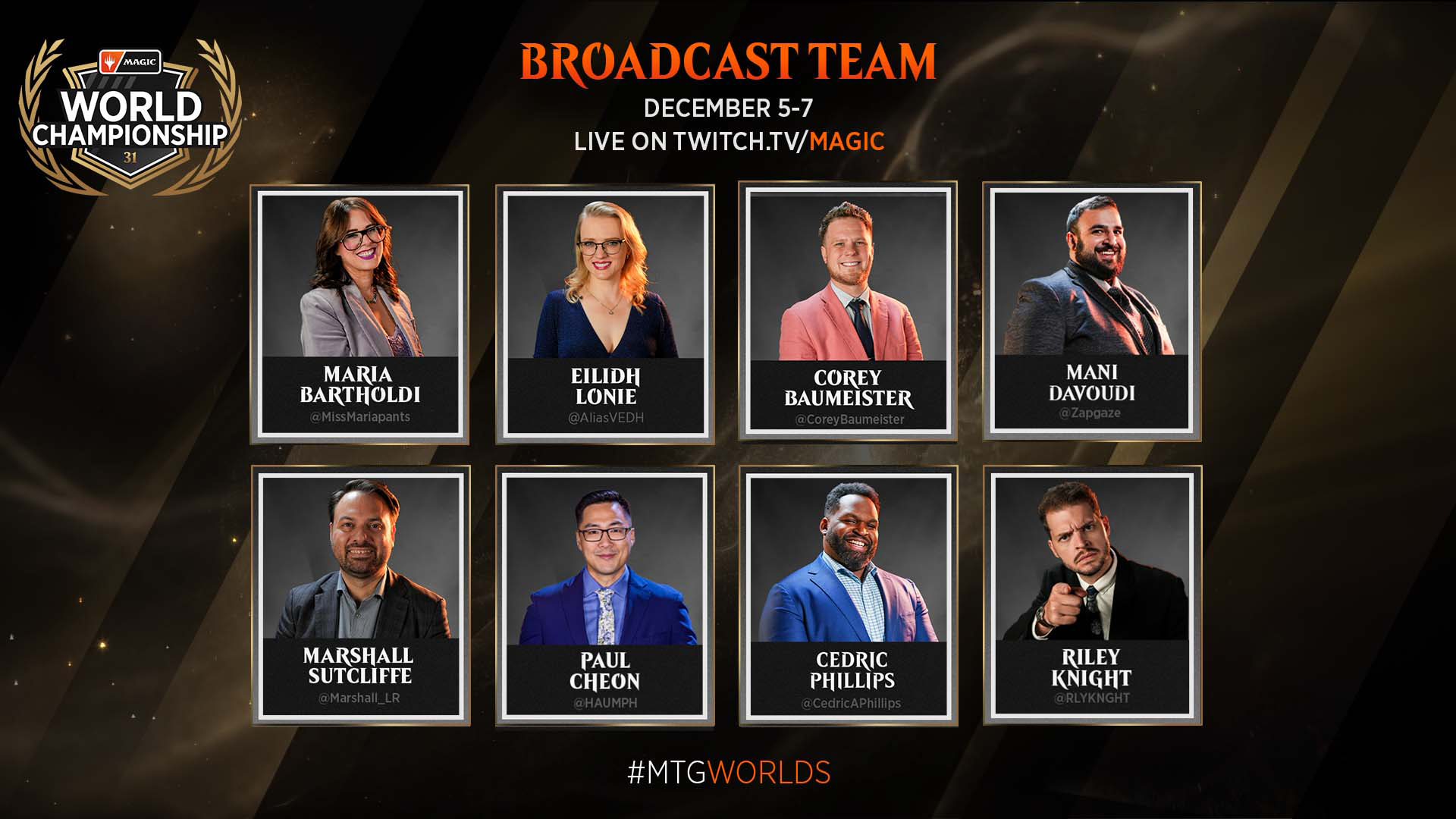
The decks are in, the data is ready, and Magic World Championship 31 begins tomorrow! From December 5–7 in Bellevue, Washington, 126 of the world's best Magic: The Gathering players will compete for their share of a $1,000,000 prize pool, the chance to be immortalized on a future Magic card, and the most prestigious title of the year.
Magic World Championship 31 represents the pinnacle of the 2024–25 Magic premier play season. Most of the competitors earned their spots through standout performances at Pro Tour Aetherdrift, Pro Tour Magic: The Gathering®—FINAL FANTASY™, and/or Pro Tour Edge of Eternities. The field also boasts Regional Championship winners and top contenders from Arena Championships, Magic Online Champions Showcases, and last year's World Championship. With such an impressive line-up, we can look forward to high-level gameplay and meticulously tuned decks.
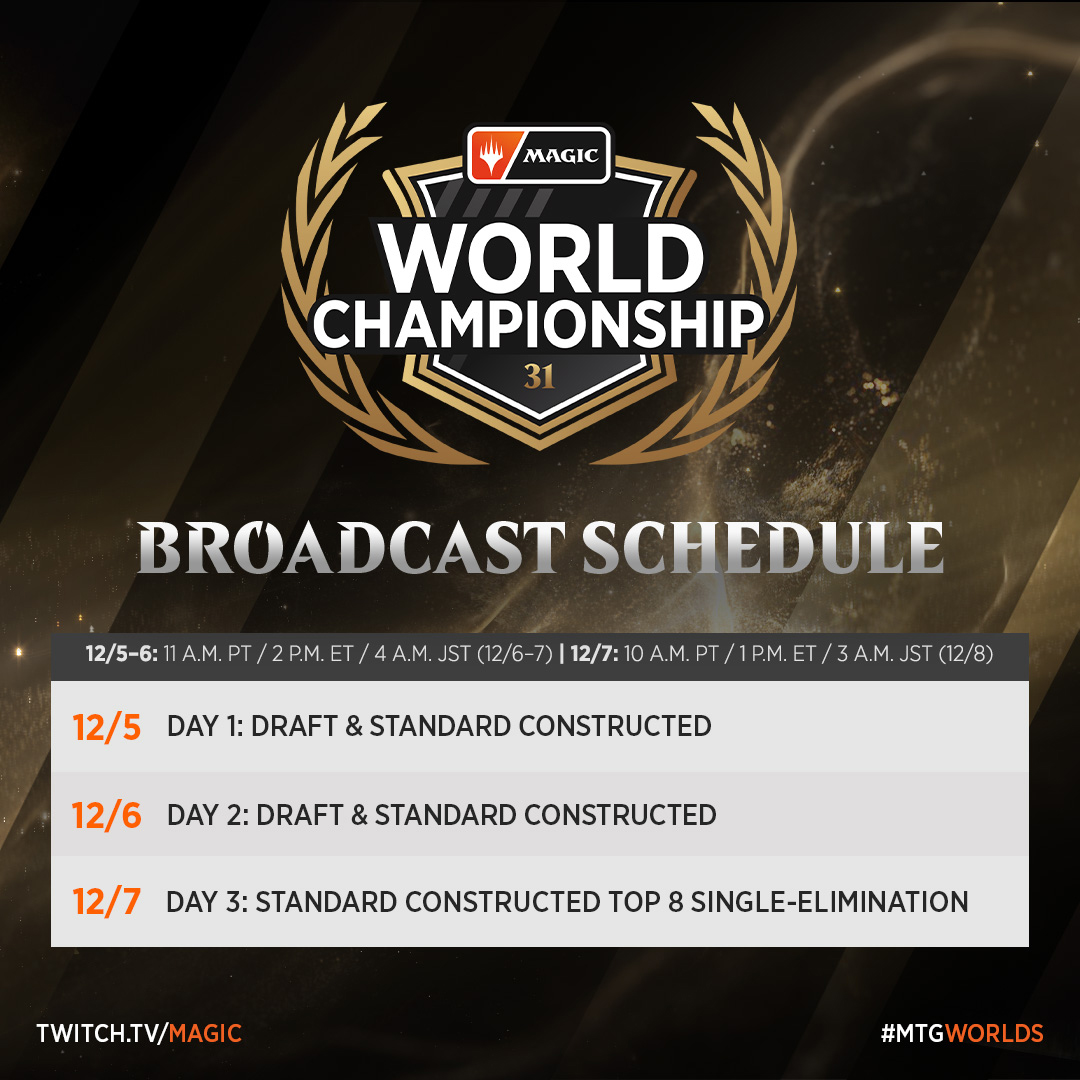
The formats are Magic: The Gathering® | Avatar: The Last Airbender™ Booster Draft in the morning on Friday and Saturday, followed by four rounds of Standard Constructed each afternoon. The Top 8 showdown on Sunday will also be Standard Construct. To catch all the action, tune in to the stream at the twitch.tv/magic or the Play MTG YouTube channel. The broadcast begins at 11 a.m. PT on Friday and Saturday and 10 a.m. PT on Sunday. For more information, be sure to check the viewer's guide.
Standard Metagame Breakdown
Standard, Magic's rotating 60-card format, currently encompasses expansion sets from Wilds of Eldraine onward. In recent weeks, the bans of
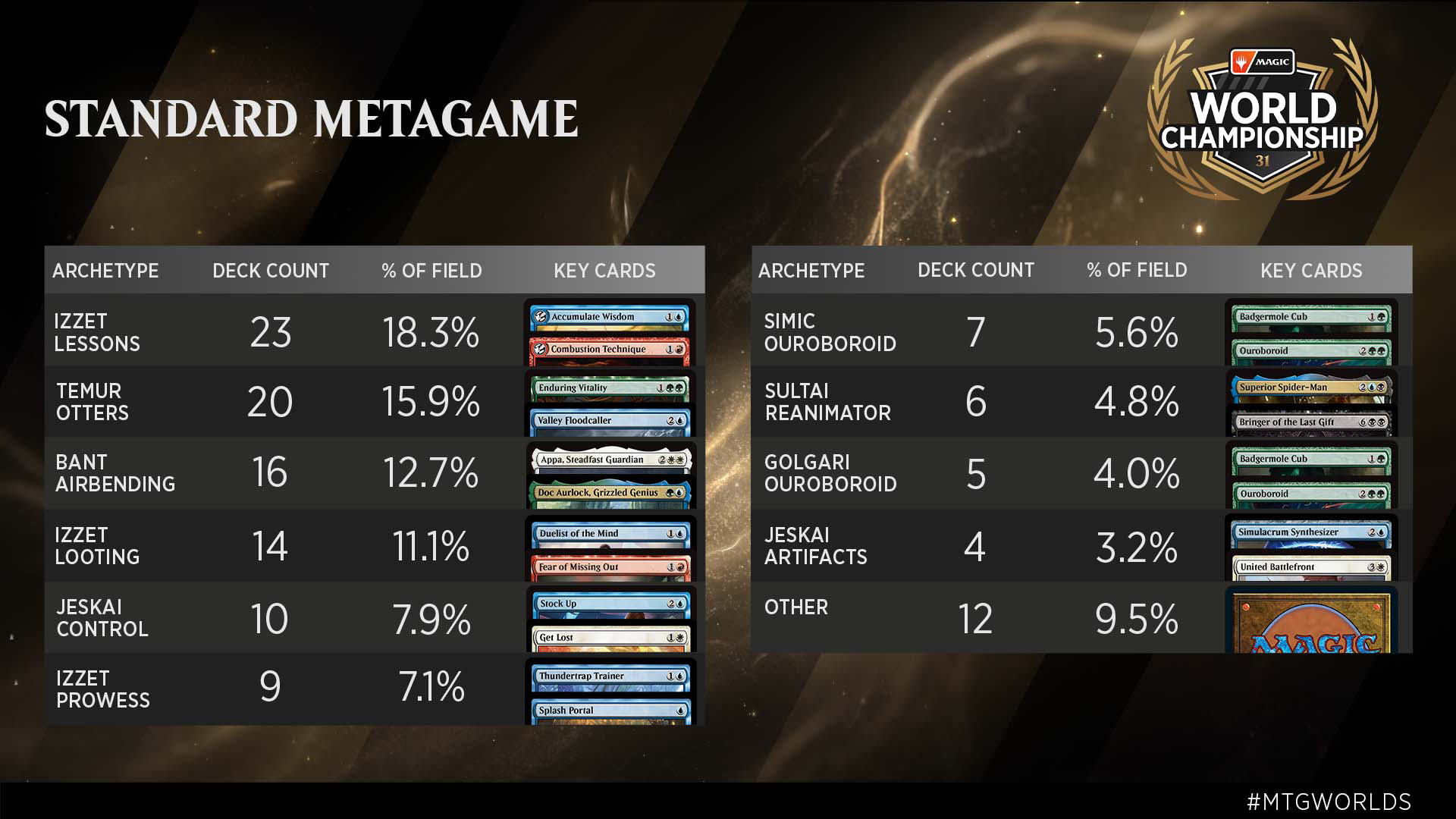
| Deck Archetype | Number of Players | Percentage of Field |
|---|---|---|
| 1. Izzet Lessons | 23 | 18.3% |
| 2. Temur Otters | 20 | 15.9% |
| 3. Bant Airbending | 16 | 12.7% |
| 4. Izzet Looting | 14 | 11.1% |
| 5. Jeskai Control | 10 | 7.9% |
| 6. Izzet Prowess | 9 | 7.1% |
| 7. Simic Ouroboroid | 7 | 5.6% |
| 8. Sultai Reanimator | 6 | 4.8% |
| 9. Golgari Ouroboroid | 5 | 4.0% |
| 10. Jeskai Artifacts | 4 | 3.2% |
| 11. Dimir Bounce | 3 | 2.4% |
| 12. Mono-Red Aggro | 3 | 2.4% |
| 13. Dimir Midrange | 2 | 1.6% |
| 14. Simic Otters | 1 | 0.8% |
| 15. Golgari Dragons | 1 | 0.8% |
| 16. Orzhov Demons | 1 | 0.8% |
| 17. Boros Mobilize | 1 | 0.8% |
The metagame showcases a broad mix of archetypes, with several surprises. Most striking is the near-absence of Dimir Midrange. Although it was the most prominent archetype to emerge from the bans completely unscathed, it disappeared from the format prior to this event. Instead, many World Championship competitors gravitated towards strategies that gained powerful upgrades from Magic: The Gathering | Avatar: The Last Airbender.
Compared to early online and tabletop events from the first week of the new format, the meteoric rise of Izzet Lessons, Temur Otters, and Bant Airbending stands out. All three rely heavily on new cards, ranging from Accumulated Wisdom to
Classic red aggro decks are not a major force, with midrange and combo decks defining most of the field. Still, games can end quickly.
Boomerang Basics
Torch the Tower
The most-played cards across all main decks are
Standard Archetype Summaries
All Standard decklists for the tournament will be published on the Magic World Championship 31 event page on Friday, December 5, at the beginning of Round 4 gameplay, at approximately 2 p.m. PT. Until then, here are brief summaries of all the archetypes.
Izzet Lessons (23 players): Izzet Lessons is the breakout Standard deck enabled by Magic: The Gathering | Avatar: The Last Airbender. Packed with Lesson cards, it effortlessly puts three of them into the graveyard. This scales up the firepower of
Temur Otters (20 players): Temur Otters features a powerful infinite loop. If you control
Bant Airbending (16 players): Bant Airbending uses its namesake mechanic to remove opposing permanents for tempo or to reset its own creatures for fresh value.
Izzet Looting (14 players): The Izzet color pair supports several strategies, all differing in their creature base. Izzet Looting maximizes draw-and-discard effects, known as looters, to fuel the new
Jeskai Control (10 players): Jeskai Control is a classic control strategy that aims to dictate the pace of the game through countermagic like
Izzet Prowess (9 players): Instead of exploiting Lessons or looters, Izzet Prowess focuses on creating tokens via
Simic Ouroboroid (7 players): With
Sultai Reanimator (6 players): Sultai Reanimator is a graveyard-centric combo deck that aims to fill the bin while digging for
Golgari Ouroboroid (5 players): Golgari Ouroboroid shares many key green cards with its Simic sibling but adds black for removal spells,
Jeskai Artifacts (4 players): Jeskai Artifacts can control the early game through
Dimir Bounce (3 players): Dimir Bounce leverages
Mono-Red Aggro (3 players): Mono-Red Aggro aims to win as fast as possible, relying on haste creatures and direct-damage spells to reduce the opponent's life total to zero. None of the lists use
Dimir Midrange (2 players): Dimir Midrange disrupts opponents with a mix of removal, discard, and countermagic while pressuring them with cheap, evasive creatures. Once
Simic Otters (1 player): Simic Otters is similar to Temur Otters but omits red for a smoother mana base. Instead of the red cards, it leverages the synergy between
Golgari Dragons (1 player): Golgari Dragons capitalizes on
Orzhov Demons (1 player): Orzhov Demons is a midrange deck that can curve
Boros Mobilize (1 player): Boros Mobilize is spearheaded by
The Most-Played Cards from Magic: The Gathering | Avatar: The Last Airbender
Magic: The Gathering | Avatar: The Last Airbender made a major impact on Standard, strengthening established archetypes and introducing powerful new build-arounds. The table below outlines all new-to-Standard cards across the 126 submitted decklists.
| Card Name | Total Number of Copies | Main Deck | Sideboard |
|---|---|---|---|
| 253 | 253 | 0 | |
| 183 | 183 | 0 | |
| 97 | 62 | 35 | |
| 92 | 92 | 0 | |
| 91 | 91 | 0 | |
| 90 | 90 | 0 | |
| 90 | 90 | 0 | |
| 78 | 75 | 3 | |
| 68 | 68 | 0 | |
| 67 | 67 | 0 | |
| 58 | 58 | 0 | |
| 43 | 43 | 0 | |
| 42 | 38 | 4 | |
| 38 | 24 | 14 | |
| 29 | 1 | 28 | |
| 26 | 26 | 0 | |
| 22 | 22 | 0 | |
| 19 | 0 | 19 | |
| 19 | 9 | 10 | |
| 15 | 0 | 15 | |
| 11 | 0 | 11 | |
| 7 | 2 | 5 | |
| 6 | 6 | 0 | |
| 5 | 5 | 0 | |
| 4 | 4 | 0 | |
| 4 | 3 | 1 | |
| 4 | 4 | 0 | |
| 3 | 0 | 3 | |
| 3 | 3 | 0 | |
| 2 | 2 | 0 | |
| 2 | 0 | 2 | |
| 1 | 1 | 0 |
Badgermole Cub [LerH8gGFQprXZ5n6Qbelh]
When it comes to raw numbers, no card left a larger footprint than
Combustion Technique
The huge suite of Lesson cards from Magic: The Gathering | Avatar: The Last Airbender enabled a brand-new archetype, which is the most-played deck at Magic World Championship 31. Key payoffs include
Appa, Steadfast Guardian [4RwnGT5ueO57mYRYXEESo0]
Sixteen competitors brought Bant Airbending, turning the new mechanic into an elegant infinite combo. With
See the Decks in Action This Weekend
Magic: The Gathering | Avatar: The Last Airbender has sparked a wave of innovation in Standard. With what feels like a brand-new format, it will be exciting to watch these Standard decks in action at Magic World Championship 31.
If you're eager to see which cards and strategies will rise to the top, and which competitor will etch their name into the annals of competitive Magic history, be sure to catch all the live action. Could Javier Dominguez become the first three-time Magic World Champion? Coverage begins Friday, December 5, on the twitch.tv/magic or the Play MTG YouTube channel!