
This year, three players will enter the Magic Pro Tour Hall of Fame: Javier Dominguez, Ken Yukuhiro and Jean-Emmanuel Depraz. All three have won major titles, and all three have made Top 8s across multiple years and formats. Yet when you study the decks behind their greatest successes, a striking pattern emerges. Each player's best decks exemplify a different high-level aspect of deck building.
The contrast is clearest at the two events where all three inductees made the Top 8 together. At Pro Tour Rivals of Ixalan in Bilbao, Spain, in February 2018, Yukuhiro reached the Top 8 with
Although these decks shared the same Top 8s, each one carries a distinct signature. Dominguez's decks are flexible, with the tools to adapt to whatever the opponent is doing. Yukuhiro's decks are unexpected, built to catch an unprepared field off guard. And Depraz's decks are fine-tuned engines, configured so that every slot pulls its weight.
In this article, we'll take a closer look at each of these approaches, the decks that embody them, and how you can apply the underlying ideas to your own deck building.
Javier Dominguez: How Can I Have a Plan Against Everything?

Most aggressive decks are built like drag racers. They are magnificent in a straight line and helpless at the first sharp corner. If the opening hand curves out, the opponent is dead by turn four. If it doesn't, there is rarely a backup plan.
Javier Dominguez's decks, by contrast, are rally cars. I've always been impressed by how his best decklists pair an aggressive core with everything needed to finish the race on rough terrain: a well-balanced sideboard, a Plan B and a Plan C, and a way to keep functioning when the best cards don't show up. These decks can attack when that's the right approach, and they can change roles when it isn't.
"I focus mostly on understanding what my plan is supposed to be in each situation I can think of," Dominguez explained, and he always puts in the work to prepare: "Tournament Magic is pretty good at presenting puzzles that are unexpected, so the more work I have done in advance, the better prepared I am!"
Five-Color Humans, the most-played deck at Pro Tour Rivals of Ixalan, may have looked like pure beatdown at first glance.
As a result, Five-Color Humans was more than just an aggro deck. Its creatures also let Dominguez take a disruptive role, attacking his opponent's plan before attacking their life total. And the sideboard extended that flexibility, as each card offered another way to adapt to a matchup. Whether through removal for creature decks, counterplay against sweepers, or interaction against spell-based strategies, his sideboard contained a plan for everything.
Seven months later, Dominguez won the 2018 World Championship with a deck that, at first glance, may look like the archetypal aggro deck of its Standard era. It had hasty threats like
The card choices supported both roles. For example, Dominguez chose
A year later, Dominguez won Mythic Championship V with Gruul Aggro, and once again the deck had an answer for the draws that didn't go according to plan. That answer was
The sideboard let the deck change roles. Against aggressive decks, Dominguez explained that "you always have the option to transform into a bigger midrange deck" with

Dominguez's instincts and knowledge extend beyond aggro. For instance, in 2019 he reached the Top 8 of Mythic Championship II with Izzet Phoenix, a deck that he said he "understood more deeply than any other during my career."
And the Dimir Demons deck that took him to victory at Magic World Championship 30 in 2024 was an
It's an example of both the value of flexible backup plans and Dominguez's thorough testing process: a lot of games, many hours of tuning a deck, and multiple meetings. As his teammate Christoffer Larsen told me, the process often includes playtest games in which Javier uses split cards to test different possibilities, with a card serving as either a
The lesson for your own deck building: For every card you would consider adding to your deck, ask what it does in the games where your main plan fails. Even in decks that look aggressive, does that card allow you to take a control role if needed? Favor cards with more than one job, give the deck ways to find its key pieces, and build a sideboard that lets you transform into a different deck when the matchup calls for it.
Ken Yukuhiro: How Can I Surprise My Opponent with an Unexpected Strategy?
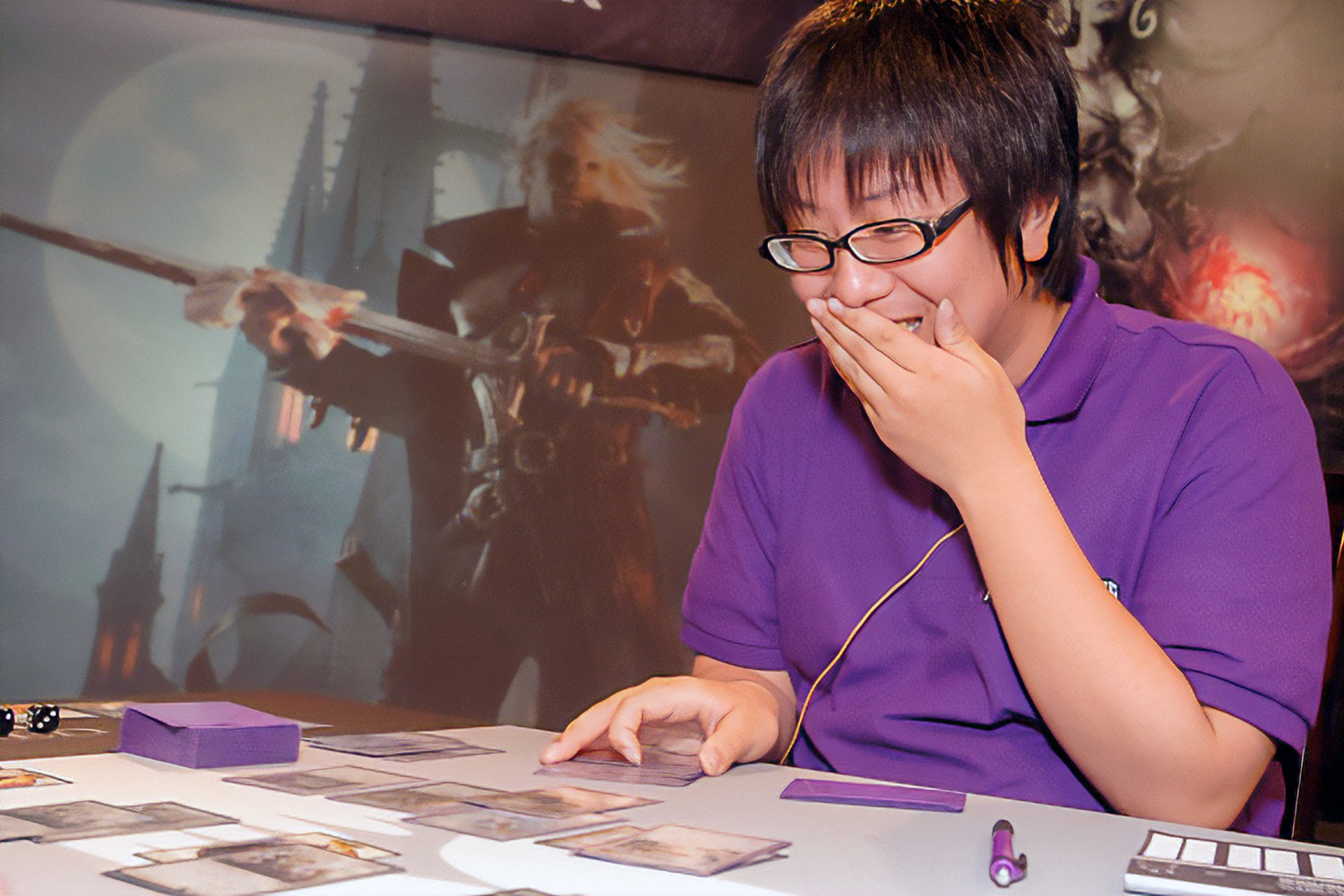
A Pro Tour metagame works a bit like an immune system. In the weeks before the event, testing teams learn to recognize the expected threats, and sideboards become antibodies. But an immune system can only fight what it has learned to recognize. Show it something truly new, and its defenses are not ready yet.
Ken Yukuhiro has built a career on finding the weird deck or unusual card that nobody else realized was good. He understands the strategic value of an unexpected strategy: opponents haven't tested against it, don't know which cards matter, and have to work out their plan on the fly.
"A consistent theme in Yukuhiro's deck choices," his compatriot and teammate Shuhei Nakamura said, "is that he opts for decks that either play to his strengths—specifically, those involving intricate combat—or operate on a different axis from the prevailing metagame, both of which make it easier for him to secure wins."
As Yukuhiro explained to me, he modestly believes that his own play skill is not always enough to set him apart if he plays the same deck as everyone else, so he often chooses options that challenge the popular strategies. "Also, I love building decks!"
At Pro Tour Rivals of Ixalan in 2018,
For opponents, familiar habits broke down. How do you catch up when Yukuhiro puts so much power and toughness into play for free? Should you spend sideboard slots on graveyard hate? And how do you plan your turns when
Surprise doesn't always require a brand-new archetype. Yukuhiro made several Top Finishes with archetypes that were played by three to four percent of the field, yet with unique card-choice twists of his own. His personal favorite was Golgari Energy at Pro Tour Amonkhet because he was the only one in the entire venue to play
The real value lay in what this did to opponents. Anyone who had prepared for a swarm of small Knights suddenly had to rethink their approach. Should they save removal for a Regisaur instead of spending it on an early Knight? Should they aim to chump block or race, and how should they plan around an enormous 7/6 that could pick up an
At Players Tour Nagoya in February 2020, the Pioneer field was bracing for Dimir Inverter, a combo deck played by nineteen percent of the room. Only two of the 192 players, about one percent, registered Sram Auras. Yukuhiro was one of them, and he took the unconventional brew all the way to the finals.
The idea was to turn a single creature into a lethal threat.
Yukuhiro lost a close final to Kenta Harane, who admitted afterward: "I'd never playtested against Ken's deck!" That sentence captures the whole strategy.

Even when Yukuhiro plays one of the most popular decks in the field, he finds room for the unexpected. When he claimed the trophy at Pro Tour Magic: The Gathering—FINAL FANTASY, his Mono-Red Aggro list was far from stock. He played four copies of
Yet as fun as brewing rogue decks and finding unique card choices can be, causing Yukuhiro to always play with a smile on his face, they still need to hold up in a competitive environment. "The support of my teammates is a big part of it," Yukuhiro said when asked what gives him the confidence to play his decks at big events. "It's important to get feedback from excellent teammates and make sure before a tournament that my ideas will actually hold up."
The lesson for your own deck building: Ask what the field isn't prepared for, whether that's an overlooked mechanic, a card most lists have cut, or a threat that operates on an unexpected axis. Don't play bad decks for the sake of being different. Start from a powerful plan and use surprise as a multiplier. Every decision your opponent has to make for the first time, in the middle of a match, is a chance for them to get it wrong.
Jean-Emmanuel Depraz: How Can I Find the Perfect Balance of Cards?

A master watchmaker can spend weeks on a single movement, adjusting gears nobody will ever see, because the reward is a mechanism in which every part has a purpose. Jean-Emmanuel Depraz's best decks have that quality. They are technically complex configurations, often powered by search effects or intricate engines, where the gap between good and great hides in a perfect mix of card types or a lone one-ofs.
Depraz isn't the type of player who shows up at a Pro Tour with a brand-new archetype nobody has seen before. His edge lies elsewhere. Assuming everyone will be up to speed, he asks himself: "In a theoretically solved metagame, what deck would best allow me to express myself?" This perspective lets him focus on finely tuning his decklists: "I just spend more time and effort trying to find the perfect balance of cards," he explained.
Accordingly, he gravitates toward decks that are packed with decisions, and he has a knack for sensing which small adjustments will make a list better. Engines and search effects reward exactly that combination. Every tutor raises the question of which card to find, every engine raises the question of how to assemble it, and every one-of is a deliberate answer to a specific game situation. The more decision points a deck offers, the more room a precise player has to gain an edge, and Depraz chooses such decks in the hope that his technical play and sequencing will give him the upper hand.
Traverse Shadow, the deck that carried Depraz to his first Top Finish in Bilbao, demands precise, carefully planned play, since every point of life paid to
To enable these cards, the list featured a perfectly balanced mix of card types. Alongside creatures, instants, sorceries, and lands, it ran four copies of
In 2019, Depraz showed off the power of Bant Golos, the most-played deck at Mythic Championship V. The deck's engine centered on
The beauty lies in the mana base. Depraz's 29 lands spanned 20 different names, with only a few repeats to ensure the deck retained enough untapped lands. The mana base was a careful balancing act between colors, names, and untapped sources. Depraz understood from Sealed that "any dual land you can play in your deck is a big deal," and Bant Golos took that idea to an extreme in Constructed. Each new land with a different name brought the horde of Zombies closer, providing inevitability in long games. Depraz reached the finals, where he lost to Dominguez, and days later
Even Depraz's World Championship-winning list, a seemingly straightforward midrange deck at first glance, was actually an elaborate, well-balanced engine.
The details reveal the craftsmanship. Of the 60 cards in the main deck, 33 were legendary, appearing as two, three, or four copies. For each legendary card, the exact number of copies achieved a delicate balance between the likelihood of drawing at least one and the risk of getting stuck with multiples. Most core engine pieces got four copies, and the rest got two or three. Deck builders can admire the beauty in each of those numbers, but it ultimately was Depraz's characteristically precise play that turned them into a trophy.
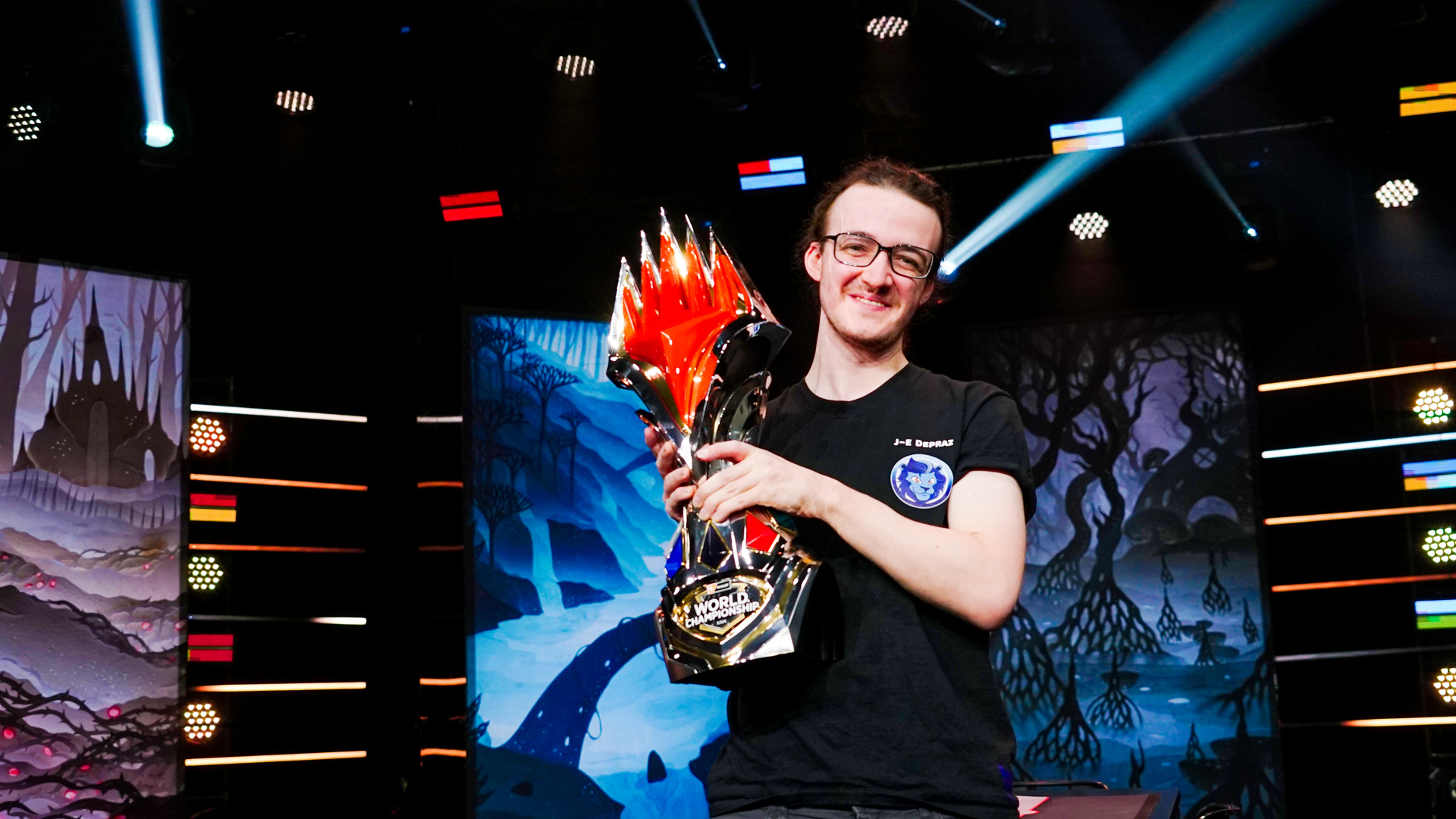
After becoming the Magic World Champion in 2023, Depraz earned the chance to have his likeness immortalized on a card. Fittingly,
When a deck presents a branching tree of complex choices every turn, a technically precise player like Depraz can squeeze out extra percentage points. That same principle was evident in the Izzet Phoenix deck he piloted to the Top 8 of Pro Tour Murders at Karlov Manor in 2024. Its intricate engine of cantrips dug toward specific one-ofs while returning one or more copies of
Out of all the decks that Depraz had taken to a premier event Top 8, that Izzet Phoenix list was actually his favorite, "Because nothing made it special." It was the deck to beat coming in, with mostly standard card counts, yet the list was perfectly tuned for in-game skill expression. As Depraz said: "I love the experience of someone telling me they're favored in a match-up just for them to find out that's not the case when the cards are played properly."
His teammates admire that Depraz always brings his A-game, though that comes with a downside. "The fact that he is so good at technical play can be challenging at times," said his teammate Fauquenoi. "We always need to adjust testing results. There is a famous story during a French bootcamp where Jean-Emmanuel went 6-0 in a matchup. Then he switched decks with his testing partner and went 6-0 again! The only thing we learned after this session is that we were playing with one of the best players in the world!"
The lesson for your own deck building: The last few percentage points rarely come from headline cards or bold innovation. They come from a deck's precise configuration, such as the one-of tutor target, the balance of card types, or the conditional answer you can dig for with card selection. Those are the elements that technically proficient players can leverage into an in-game edge. So once a deck's core is settled, go through the list slot by slot and picture how each card supports the deck's engine and its tutors.
Conclusion
Put the six decks from Bilbao and Long Beach side by side again, and they no longer look like a random sample. Dominguez's Five-Color Humans and Gruul Aggro were built to handle every corner of the format. Yukuhiro's
No single philosophy is the right one, and great players borrow from all three. So, before your next tournament, ask all three questions. Does my deck have a plan against everything? Is there a strategy that my opponents won't see coming? And have I found the perfect balance of cards?
On November 15, Javier Dominguez, Ken Yukuhiro, and Jean-Emmanuel Depraz will be inducted into the Magic Pro Tour Hall of Fame at MagicCon: Atlanta, with the ceremony streamed live on twitch.tv/magic and the Play MTG YouTube channel before the finals of Magic World Championship 32. Tune in to celebrate three remarkable careers, and the next time you build a deck, channel the approaches of these masterminds.